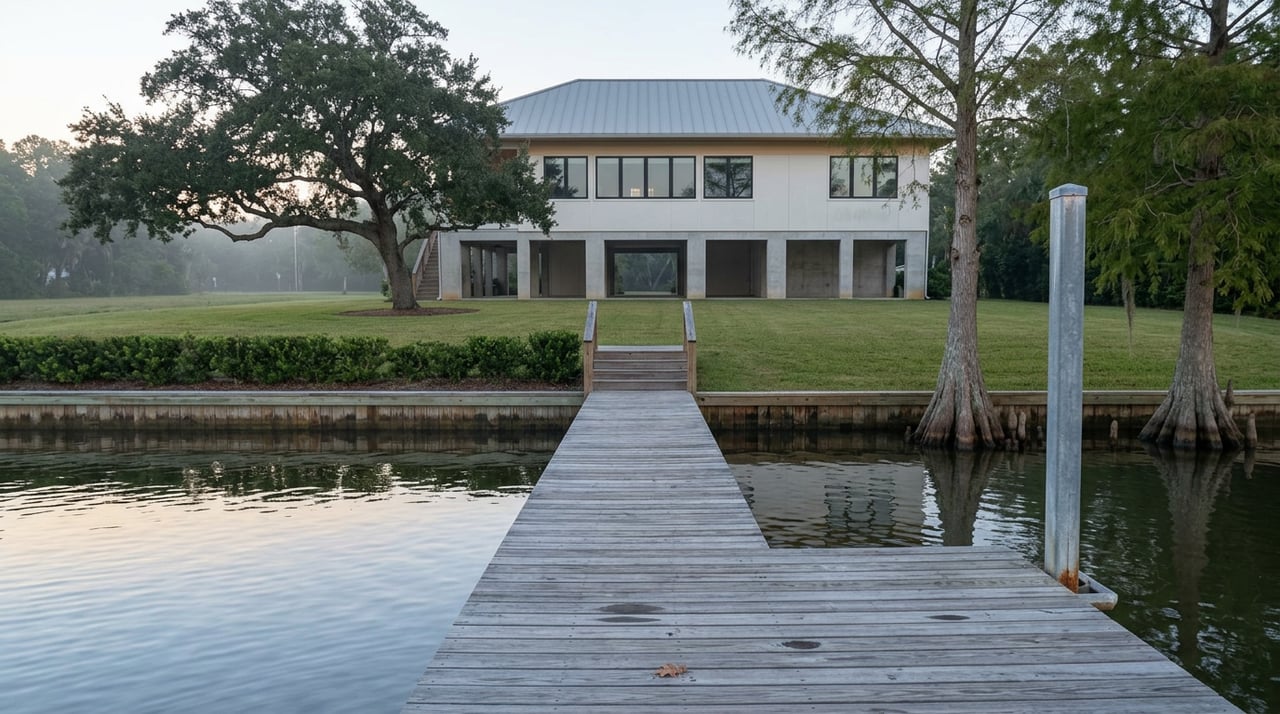
The Tchefuncte Waterfront Numbers That Show Up After You Close
September 17, 2026
September 17, 2026
You found the house. The dock is solid, the view is the one you pictured when you started looking, and the offer got accepted faster than you expected. Then two things happen that nobody mentioned during the showing: your insurance quote comes back with a deductible structure you've never seen before, and you start asking who you'd call to fix the dock, only to learn that "fixing the dock" is not a weekend project. It's a permitting project, and it touches four different offices before anyone picks up a hammer.
This is the part of buying on the Tchefuncte River that the listing price never shows you. The median tells you what the house costs. It doesn't tell you what it costs to insure it the way waterfront insurance actually works, and it doesn't tell you what it takes to touch anything below the high-water line once you own it.
Most buyers assume their homeowners deductible is one number. On Madisonville waterfront property, it's two.
Your standard deductible covers the ordinary stuff: a kitchen fire, a burst pipe, the ordinary bad luck of owning a house. But a separate named-storm deductible kicks in for wind or storm-surge damage tied to a hurricane or tropical storm, and it isn't a flat dollar figure. It's typically calculated as 2 to 5 percent of your dwelling coverage. On a home insured for $400,000, that's $8,000 to $20,000 out of pocket before your insurer pays anything toward hurricane damage, a range confirmed by Chabert Insurance's Madisonville-specific coverage breakdown. Waterfront lots closer to the shoreline often land at the higher end of that range, and some carriers won't write a waterfront policy at all without the 5 percent threshold.
You can sometimes buy that deductible down to a flat dollar amount. Expect to pay 15 to 25 percent more in annual premium for the privilege, and know that the buyback option isn't always available for waterfront parcels in the 70447 zip code in the first place. This is a conversation worth having with an insurance agent before you write an offer, not after your inspection period has already started.
There's a second, smaller gotcha in the same policy. After a storm, your insurance typically covers the structural damage a fallen pine does to your house. It does not typically cover the full cost of removing the tree. Debris removal is usually capped at $500 to $1,000 per tree, with a total policy limit of $2,500 to $5,000. On a wooded Tchefuncte lot with mature oaks and pines, that cap can leave a real gap between what the storm costs and what the policy pays.
Louisiana's homeowners insurance market has actually calmed down this year. Statewide average rate changes had dropped to roughly 0.1 percent by mid-2026, a real shift after several volatile years. But that stabilization is a statewide average, and waterfront property in a river town doesn't experience the average.
In Madisonville, waterfront homes and older roofs frequently end up placed with surplus lines carriers rather than admitted carriers. Admitted carriers are regulated by the Louisiana Department of Insurance and participate in the state's guaranty fund, which protects you if the insurer becomes insolvent. Surplus lines carriers aren't bound by the same rate regulation and don't participate in that guaranty fund. That isn't automatically bad. Surplus lines carriers can be financially strong and often represent the only real option for a higher-risk waterfront property. It just means the safety net looks different than the one your inland friends are describing over dinner, and it's worth understanding which kind of carrier is quoting you before you're three weeks from closing.
Here's the part that surprises people who've owned property elsewhere. On the Tchefuncte, work on a dock, pier, bulkhead, or shoreline stabilization isn't a single permit. It's a stack.
Louisiana law is explicit that this isn't optional paperwork. State statute requires a permit before anyone constructs, alters, or maintains a wharf, pier, dock, bulkhead, or similar structure in these waters. That requirement applies whether you're building new or repairing what's already there.
The Tchefuncte adds a wrinkle most inland buyers don't think about. The river carries both current and lake-influenced water levels where it opens into Lake Pontchartrain, which means a dock built for a calm pond simply isn't engineered for what this stretch of water actually does. If you're inheriting a dock that looks fine today, it's worth asking when it was last permitted and whether it was built to standards that account for that mix of current and tide.
Louisiana's riparian rights give waterfront owners reasonable use of the water and some ability to build out toward the navigable channel. But the state still owns the submerged land itself and holds public servitudes over it. Owning a waterfront lot doesn't automatically mean owning the water in front of it the way you own your lawn.
Before you assume anything about your access, your dock rights, or your ability to expand a structure, verify what your deed actually includes, whether any easements are recorded against the property, and what the local setbacks require. This is a five-minute conversation with a title company that can save months of confusion later.
If a property sits in a high-risk FEMA flood zone, your lender will almost certainly require flood insurance as a condition of the loan. What most buyers don't ask for early enough is the elevation certificate, the document that establishes your home's elevation relative to the base flood elevation on the FEMA map for that stretch of the Tchefuncte.
An elevation certificate can move your flood premium significantly in either direction. If the seller has one on file, ask for it during your inspection period. If they don't, get a quote for a new survey before you're locked into a closing date, not after. The Louisiana Department of Insurance maintains consumer guidance on flood coverage that's worth reading alongside whatever your agent or lender provides.
As of September 2026, Madisonville's overall median list price sits around $455,000. Waterfront listings run a real premium above that: as of this writing, 33 waterfront homes were active on the market with a median list price of $486,000, and only one waterfront home had sold in the prior month. That's a thin market. When only one or two comparable sales happen in a given stretch, the individual terms of your transaction (your deductible structure, your carrier type, the permit history on your dock) carry more weight than they would in a faster-moving market where a dozen recent sales set clear expectations.
None of that shows up in the median. It shows up in your insurance quote and your permit timeline, both of which surface after you're already emotionally committed to the house.
Does a dock's existing permit transfer to a new owner? Permits are typically tied to the structure and the property, not the individual who filed for it, but that doesn't mean every existing dock was built to current standards or has clean paperwork on file. It's worth asking your agent to help confirm permit history before closing rather than assuming continuity.
Do I need a new permit just to repair storm damage to an existing dock? Often yes. Repairs, alterations, and maintenance of a wharf, pier, dock, or bulkhead fall under the same permitting requirement as new construction under Louisiana law, so a like-for-like repair can still require sign-off from the same layers of review.
Is a flood insurance requirement the same thing as a named-storm deductible? No, and this is where a lot of buyers get confused. Flood insurance covers rising water and is often a separate policy required by your lender if you're in a high-risk zone. The named-storm deductible lives inside your homeowners policy and applies to wind and storm-surge damage tied to a named hurricane or tropical storm. You can carry both, and most Tchefuncte waterfront owners do.
If you're weighing a purchase on the Tchefuncte or anywhere else on the Northshore's waterways, these are exactly the conversations worth having before you write an offer, not after. Patricia Conaghan works this market every week and can walk you through what a specific property's insurance and permit picture actually looks like. Let's talk about your next move.
Stay up to date on the latest real estate trends.
Patricia has a comprehensive understanding of the market and is skillful in strategic pricing and marketing. She believes her clients are #1. It's all about her clients and their best interests. Patricia helps people every step of the way when purchasing or selling homes, providing professional and trustworthy full service.